Can Construction Make You a Millionaire? The Real Path to Wealth in the Industry

Construction Profit & Revenue Calculator
Calculate Your Profit Potential
Profit Analysis
Recurring Revenue Model
Your recurring revenue model needs 0 contracts to reach $1M profit
Every year, hundreds of people start construction companies. A few of them end up with multi-million-dollar businesses. Most don’t. The difference isn’t luck. It’s strategy. If you’re wondering if construction can make you a millionaire, the answer isn’t yes or no-it’s how.
Most construction businesses fail before they hit $1 million
According to the National Association of Home Builders, nearly 60% of small construction firms close within five years. Why? They treat construction like a trade, not a business. They take every job that comes in, work 70-hour weeks, and never raise their prices. They’re skilled carpenters or electricians who got good at running crews-but never learned how to run a company.
Being good at installing roofs or pouring concrete doesn’t make you rich. Making money in construction means you’re good at managing cash flow, pricing jobs right, and scaling without burning out. The millionaires in this industry aren’t the ones swinging hammers. They’re the ones who built systems that let others swing hammers for them.
Profit margins aren’t what you think
Most people assume construction is a high-margin business. It’s not. The average net profit for a residential contractor is 4-6%. For commercial work, it’s closer to 5-8%. That means if you do $2 million in sales, you’re taking home $100,000 at best. That’s not millionaire money.
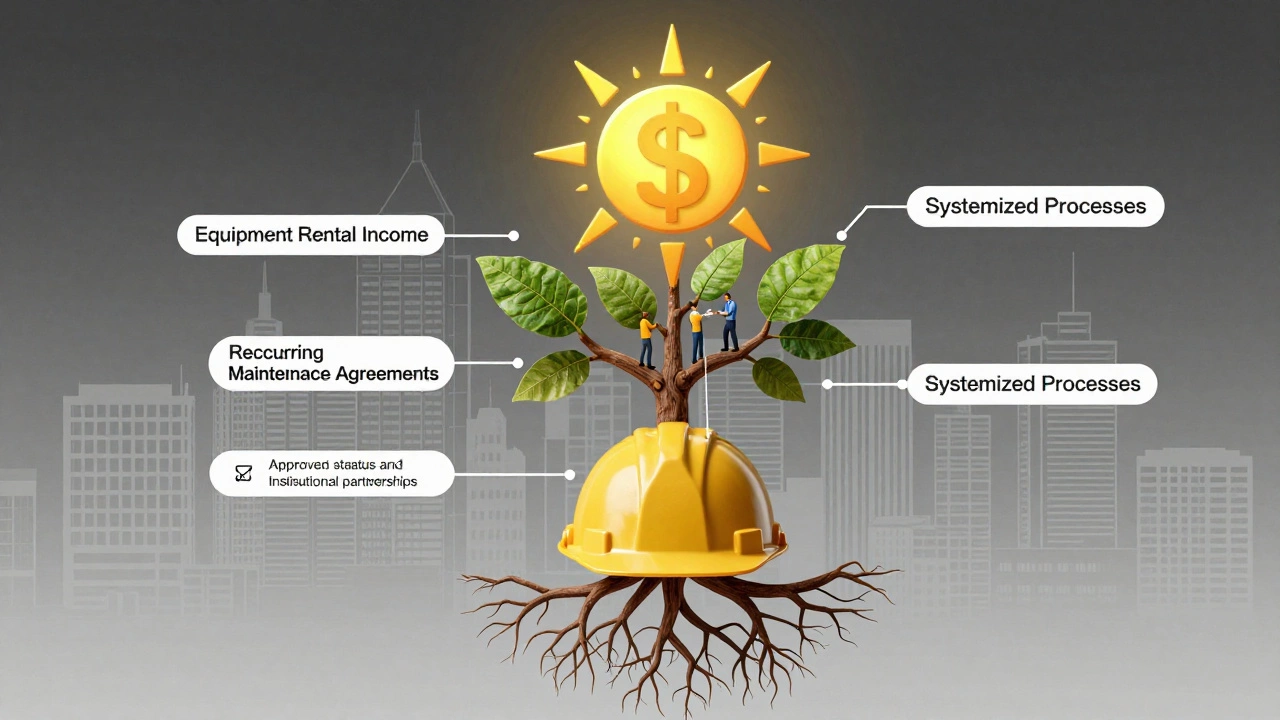
But here’s what changes everything: repeating revenue. The real money isn’t in one-off jobs. It’s in contracts that keep coming. Think property management companies that need regular maintenance. Developers who need the same crew for every new building. Government contracts for infrastructure repair. These aren’t one-time gigs-they’re pipelines.
One company in Ohio started as a small roofing crew. Now they manage 14 commercial properties under long-term service agreements. They don’t bid on new jobs every month. They get paid monthly, year after year. Their profit margin? 22%. Because they eliminated the cost of constantly chasing work.
Scale isn’t about hiring more people-it’s about standardizing
Many contractors think scaling means hiring 10 more crews. That’s a recipe for disaster. More people means more payroll, more scheduling headaches, more liability. The smart ones scale by systemizing.
Take a company in Texas that specializes in bathroom remodels. They don’t have 50 employees. They have one blueprint. Every bathroom job follows the same 12-step process: demolition → plumbing rough-in → framing → waterproofing → tiling → fixture install → inspection → cleanup. They train every crew member on that exact sequence. They buy materials in bulk using the same vendors. They use the same subcontractors for electrical and HVAC.
Result? They can turn a bathroom job around in 10 days, every time. Their overhead dropped 30%. They doubled their output without hiring more staff. They now do $4.2 million a year in revenue. And they’re profitable on every single job.

The hidden profit center: equipment and tools
Most contractors see equipment as a cost. The smart ones see it as an asset. If you own a crane, a concrete pump, or even a fleet of dump trucks, you’re not just using them-you’re renting them out.
A small commercial contractor in Florida bought a 25-ton crane for $180,000. He used it for his own projects. Then he started renting it to other builders on weekends. Now he earns $1,200 per day renting it out. He paid off the crane in six months. Today, it brings in $300,000 a year in pure profit.
Same goes for tools. A company in Georgia bought 20 high-end saws and started renting them to independent framers. They charge $50 per day. They don’t even have to be on-site. The renters pick up and drop off at their warehouse. That side business now makes more than their core contracting work.
Who really makes the money? The ones who own the contracts
The biggest earners in construction aren’t the ones doing the work. They’re the ones who control the contracts. Think of it like this: a general contractor hires subs. The subs do the work. The general contractor takes 15-25% of the job value just for managing the project.
One guy in Atlanta started as a plumbing sub. He noticed how often developers kept hiring the same GCs. He learned how to write proposals. He built relationships with architects. Now he’s the go-to general contractor for 12 luxury apartment buildings a year. He doesn’t lay a single brick. He doesn’t run a single wire. He just coordinates everything-and pockets $400,000 per project.
That’s the power of position. If you can get on the list of approved contractors for a major developer, a city government, or a hospital system, you’ve locked in years of steady income. No more bidding wars. No more lowball offers.
What you need to stop doing
Stop undercharging. If you’re charging $45 an hour for labor, you’re leaving money on the table. The average hourly rate for a skilled tradesperson in 2026 is $72. If you’re not charging that, you’re not a contractor-you’re a laborer with a truck.
Stop working for free. If a client asks for a change order and says, “We’ll pay you next time,” walk away. That’s how you end up with $80,000 in unpaid invoices and no way to pay your crew.
Stop doing residential remodels if you want to scale. The margins are thin. The jobs are unpredictable. The clients are emotional. Commercial work, government contracts, and institutional projects? They pay on time. They pay more. They need consistency. That’s where the real wealth is built.
How to start if you’re not already in the game
You don’t need $500,000 to start. You need one thing: a niche you can dominate.
Find a problem that’s annoying but overlooked. Maybe it’s installing solar panels on flat commercial roofs. Maybe it’s retrofitting old warehouses with energy-efficient lighting. Maybe it’s removing asbestos from schools before renovation.
Get certified. Get insured. Build a simple website. Start small. Do three jobs perfectly. Ask for testimonials. Then raise your price by 50%. Repeat.
Within three years, if you’ve stayed focused, you’ll have a business that’s worth $2 million. Not because you worked harder. Because you worked smarter.
It’s not about how hard you work-it’s about how you’re paid
There are thousands of construction workers who make $60,000 a year. They’re skilled. They’re reliable. They’re honest. But they’re not millionaires.
There are maybe 200 construction business owners who make $2 million a year. They’re not necessarily better at sawing wood or laying brick. They’re better at structuring deals, owning assets, and creating systems that make money while they sleep.
Construction doesn’t make you rich because you build houses. It makes you rich because you build businesses that build houses-for other people.