What Size Coffee Table Should I Get Compared to My Couch?

Coffee Table Size Calculator
Getting the right coffee table size isn’t just about style-it’s about function. Too small, and you’re constantly reaching for your drink. Too big, and you can’t walk around your sofa without bumping into it. The truth is, most people pick a coffee table based on how it looks in a catalog, not how it fits in their actual living room. That’s why so many end up with tables that feel awkward, out of place, or just plain useless.
Start with your couch
Your couch is the anchor of your living room, and your coffee table should work with it, not against it. The golden rule? The coffee table should be about two-thirds the length of your sofa. So if your couch is 84 inches long, aim for a table around 56 inches. This ratio creates balance. It leaves enough space on either side for walking and for side tables, without making the table look lost or overwhelming.
But length isn’t everything. Height matters just as much. A coffee table should be roughly the same height as your couch cushion-give or take an inch. Most couch cushions sit between 16 and 18 inches off the floor. That means your coffee table should be between 15 and 17 inches tall. If it’s too low, you’ll be bending over every time you set down your mug. Too high, and your legs hit it when you sit back.
Leave room to move
Think about how you use the space. Do you have kids running around? Do you often have guests over? Then you need breathing room. Keep at least 18 inches of clearance between the coffee table and the front of your couch. That’s about the width of a standard footstep. If you have a sectional, measure from the edge of the seating area, not the armrests.
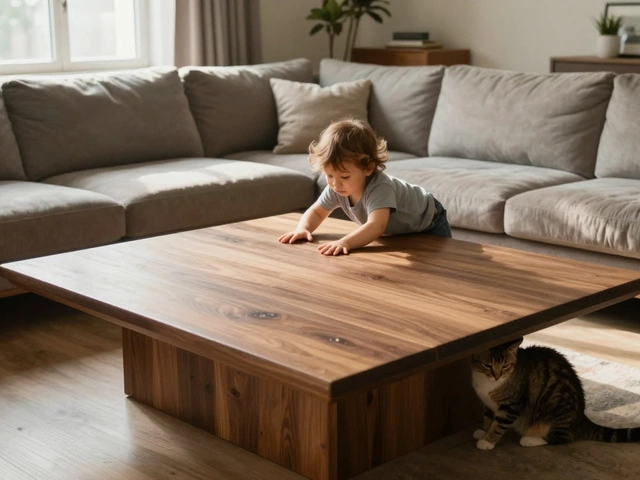
Here’s a real-world example: A family with a 90-inch L-shaped sectional and two young kids chose a 54-inch table. They got it right. The table was long enough to hold snacks, books, and remote controls, but short enough that their toddler could crawl under it without tripping. They also left 20 inches between the table and the sofa-perfect for walking around without knocking over a lamp.
Shape matters more than you think
A rectangular table works best with a straight, linear sofa. It mirrors the shape and feels intentional. But if you have a rounded sectional or a curved couch, go for an oval or round table. Sharp corners on a square table can feel hostile next to a soft, curved sofa. Round tables also make it easier to move around the space-no one’s going to bump their shin on a curved edge.
Don’t forget about depth. Most coffee tables are 18 to 20 inches deep. If you have a deep, plush sectional, a shallow table (under 16 inches) will look like a coaster. Too deep, and it’ll crowd the space. Stick to 18 inches unless your couch is unusually low or high.
What about small spaces?
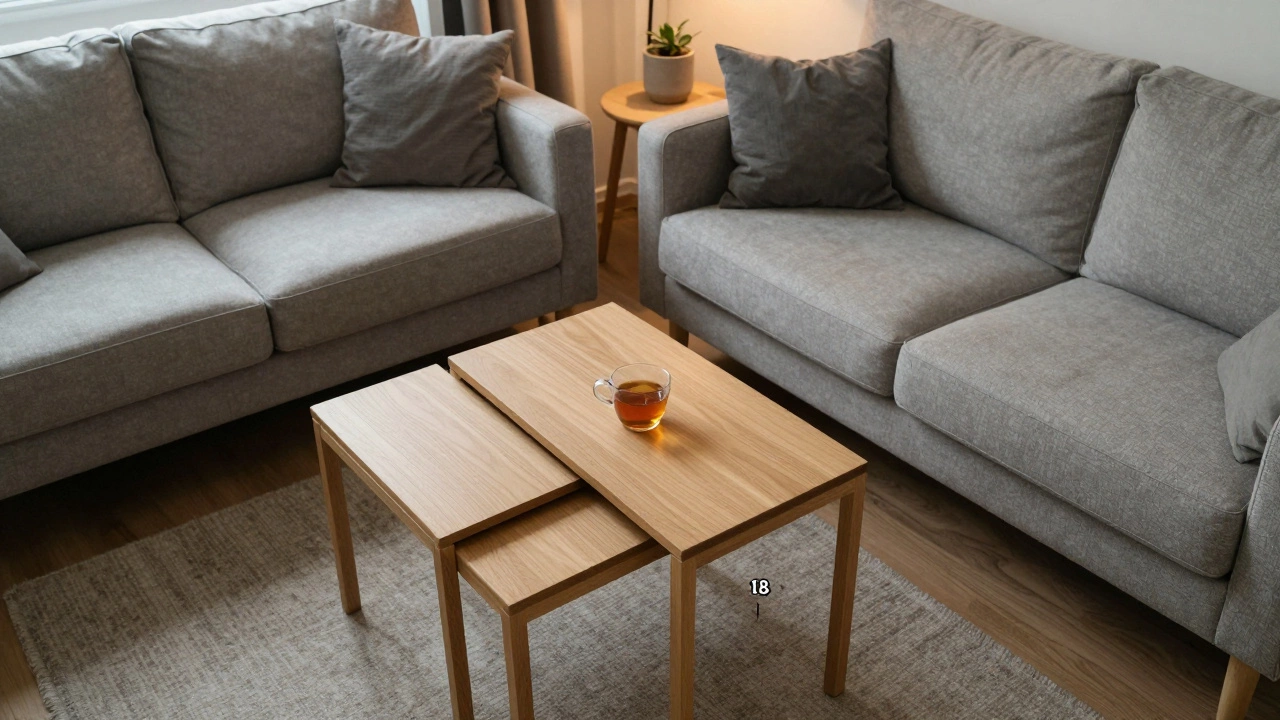
If your living room is tight-say, under 12 feet wide-don’t panic. You don’t need a massive table. In fact, going smaller can help. A 40-inch table or even a pair of small nesting tables can work better than one big piece. Nesting tables let you pull out just what you need, tuck them away when you’re not using them, and still have room to walk. Some people even skip the coffee table entirely and use a sturdy ottoman instead. It doubles as seating, storage, and surface-perfect for apartments or compact homes.
What not to do
Don’t pick a table just because it’s on sale. Don’t buy one because it matches your rug. Don’t assume that bigger is better. I’ve seen people buy 72-inch tables for 60-inch couches, thinking it looked “luxurious.” In reality, it blocked the view of the TV, made it hard to get up from the sofa, and turned the whole room into a traffic jam.
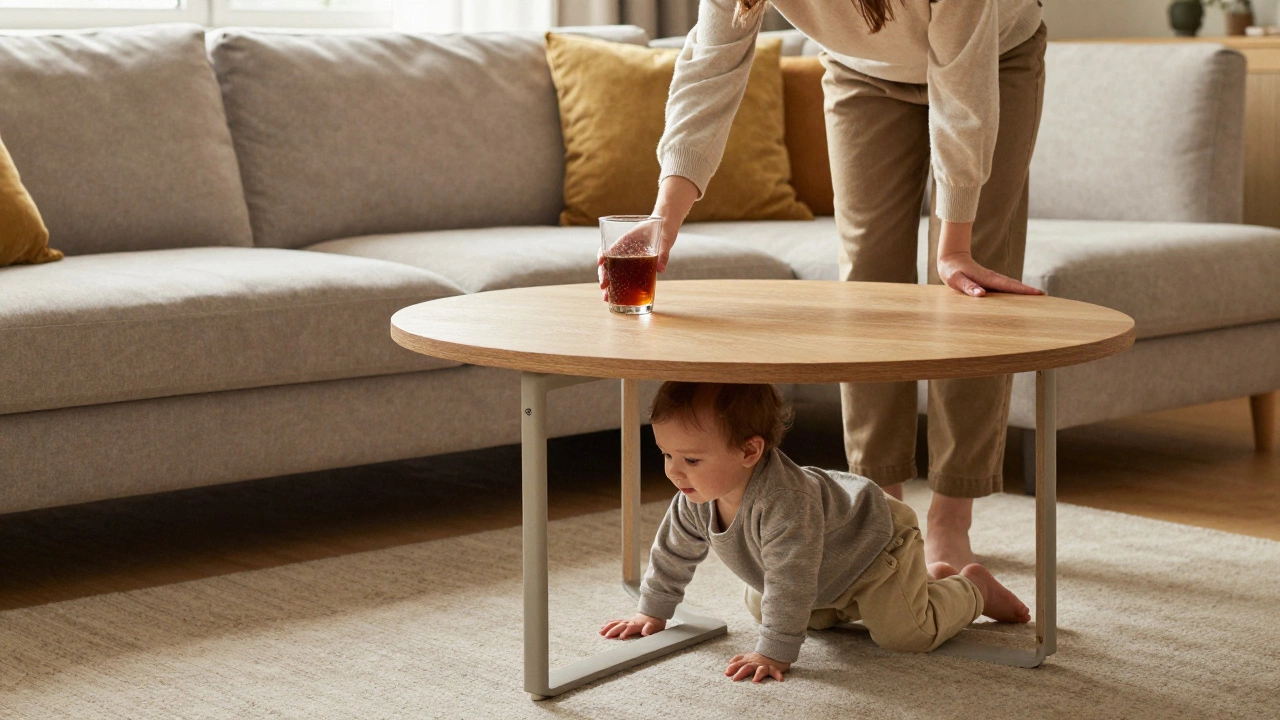
Also, avoid tables with legs that are too thin or too tall. They look elegant in photos, but in real life, they get in the way of feet and pets. Solid, low-slung bases are more stable and feel more grounded. And if you’re using a glass top, make sure it’s tempered. It’s not just about safety-it’s about durability. Glass tables scratch easily, and if they’re too thin, they’ll feel flimsy.
Test it before you buy
Before you hand over your money, try this: Use painter’s tape to mark the outline of the table you’re thinking of on your floor. Put a box or stack of books on top to simulate the height. Sit on your couch. Can you reach it comfortably? Can you walk around it? Can your dog fit under it? If the answer to any of those is no, keep looking.
Measure twice, buy once. Keep a tape measure handy. Write down the length of your couch, the height of your cushion, and the width of your walking space. Then compare it to the table specs. Most online retailers list exact dimensions. Don’t guess. Don’t assume. Measure.
Final checklist
- Is the table about two-thirds the length of your couch?
- Is the height within an inch of your couch cushion?
- Is there at least 18 inches between the table and the sofa?
- Does the shape match your couch’s lines (rectangular for straight, round for curved)?
- Is the depth between 16 and 20 inches?
- Have you tested the space with tape or a mock-up?
There’s no magic number. But if you follow these steps, you’ll avoid the most common mistakes. Your coffee table shouldn’t dominate the room-it should support it. A well-sized table makes your living room feel intentional, comfortable, and lived-in. Not cramped, not cluttered, not awkward. Just right.