Medicare Coverage for Lift Chairs: What You Actually Pay in 2026
Medicare Lift Chair Cost Estimator
Use this tool to estimate how much you will pay versus what Medicare covers based on the current 80/20 split rules.
Cost Breakdown
Note: This calculation assumes Original Medicare Part B. If you have Medicare Advantage, contact your plan as rules may vary. The "Furniture Cost" represents the portion of the chair not covered by any insurance.
Buying a lift chair is rarely just about comfort. For many seniors and people with mobility issues, it’s the difference between staying independent at home or facing a risky fall when trying to stand up from a low sofa. But here is the hard truth that catches most families off guard: Medicare does not pay for the chair itself. It only pays for the lifting mechanism.
If you are looking at a $1,500 recliner online and expecting Medicare to cover a chunk of that price tag, you will be disappointed. The program has very specific, narrow rules about what qualifies as medically necessary. Understanding exactly how the payment split works-and what portion falls on your wallet-is critical before you sign any contracts or order anything.
The Core Rule: Mechanism vs. Chair
To understand the percentage Medicare pays, you first have to separate the product into two distinct parts. In the eyes of the Centers for Medicare & Medicaid Services (CMS), a lift chair is not one item. It is a combination of a piece of furniture and a piece of medical equipment.
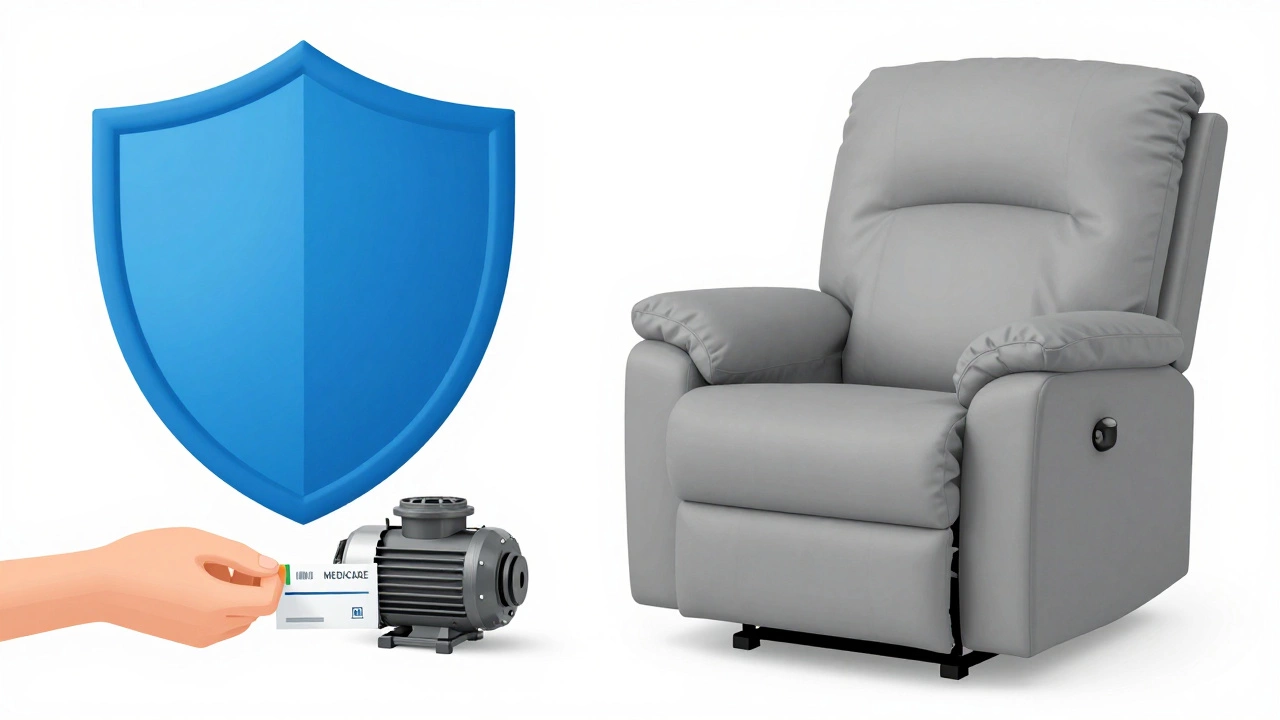
Medicare Part B covers durable medical equipment (DME) that is medically necessary for use in the home. This includes the motorized lift mechanism that helps you stand up. However, the chair frame, upholstery, cushions, and remote control are considered household furniture. Furniture is never covered by Medicare.
This distinction is vital. When you see a quote for a "lift chair," it usually bundles both costs together. Medicare will only reimburse its share for the mechanism component. If you buy a cheap chair with an expensive motor, or an expensive leather chair with a basic motor, the math changes drastically for your out-of-pocket costs.
What Percentage Does Medicare Pay?
Assuming you meet all the strict eligibility requirements, here is the standard payment breakdown under Original Medicare (Part B):
- Medicare Pays: 80% of the Medicare-approved amount for the lift mechanism only.
- You Pay: 20% of the Medicare-approved amount for the mechanism, plus 100% of the cost of the chair itself.
It is important to note that "Medicare-approved amount" is not the same as the retail price. Medicare sets its own fee schedule for DME. Even if a supplier charges $1,000 for a mechanism, Medicare might only approve $600. You would calculate your 20% copay based on that $600, not the $1,000.
Let’s look at a realistic scenario in 2026. Imagine you find a lift chair where the total retail price is $1,200. Let’s say the manufacturer breaks this down as $400 for the mechanism and $800 for the chair.
- Step 1: Determine the approved amount for the mechanism. Let’s assume Medicare approves $350 for this specific motor type.
- Step 2: Calculate Medicare’s share. 80% of $350 is $280. Medicare pays this directly to the supplier.
- Step 3: Calculate your copay. 20% of $350 is $70. You owe this amount.
- Step 4: Add the cost of the chair. You pay the full $800 for the furniture part.
- Total Out-of-Pocket: $70 (copay) + $800 (chair) = $870.
In this example, even though the chair cost $1,200, you ended up paying $870 out of pocket because Medicare only touched the mechanism. If you had bought a cheaper chair frame, your total cost would have been lower.
Eligibility: Why Many Claims Get Denied
Getting that 80% payment isn’t automatic. You must pass several hurdles. If you miss one, Medicare pays 0%, and you are responsible for the entire bill.
| Requirement | Details |
|---|---|
| Medical Necessity | You must have a condition that makes standing difficult without assistance. Common conditions include severe arthritis, muscle weakness, or post-surgical recovery. |
| Physician Order | A doctor must write a prescription specifically stating the need for a lift chair mechanism. A general note saying "patient needs help moving" is often insufficient. |
| Use in Home | The device must be used in your primary residence. It cannot be for a vacation home or a nursing facility. |
| Functional Limitation | Your doctor must certify that you cannot rise from a seated position without using your arms or upper body strength significantly, posing a safety risk. |
The biggest pitfall here is the physician’s documentation. Many doctors are busy and may not know the specific language Medicare requires. They might write "for comfort" instead of "to prevent falls due to inability to stand." Always ask your doctor to be explicit about the functional limitation.
Original Medicare vs. Medicare Advantage
If you have Original Medicare (Part A and Part B), the rules above apply strictly. However, if you are enrolled in a Medicare Advantage Plan (Part C), your experience might be different.
Medicare Advantage plans are offered by private insurance companies that contract with Medicare. These plans must cover everything Original Medicare covers, but they can offer additional benefits. Some MA plans include extra allowances for durable medical equipment or even cover certain types of furniture modifications, though this is rare.
Before buying anything, call your plan provider. Ask them these three questions:
- Do you cover the lift mechanism under Part B?
- Is there a separate allowance or benefit for the chair frame?
- Do I need to use a specific network of DME suppliers?
If you use a non-participating supplier with Original Medicare, they can charge up to 15% more than the approved amount (known as limiting charge), and you might have to pay upfront and file for reimbursement later. With Medicare Advantage, going out-of-network could mean zero coverage at all.
How to Minimize Your Costs
Since you are likely paying for the majority of the chair, smart shopping matters. Here is how to keep your out-of-pocket expenses manageable.
1. Buy the Mechanism Separately Some specialized DME suppliers sell just the lift mechanism. You can then install it into a chair you already own or buy a inexpensive recliner separately. This ensures you aren't paying a premium for high-end upholstery that Medicare won't touch. However, ensure the mechanism is compatible with the chair frame.
2. Check for State Medicaid Waivers If you have dual eligibility (both Medicare and Medicaid), your state’s Medicaid program might cover the chair portion. Medicaid rules vary wildly by state. In some states, home and community-based services waivers include funding for adaptive furniture. Contact your local Department of Social Services to check.
3. Look for Veteran Benefits If you are a veteran, the VA may provide a lift chair through their Adaptive Equipment Program. This is separate from Medicare and often covers the entire unit if deemed medically necessary for your service-connected disability.
4. Consider Used Options Because the chair part is purely cosmetic and structural, buying a gently used lift chair from a reputable reseller can save hundreds of dollars. Just ensure the motor still functions correctly and that you can get a new prescription for the mechanism if needed for warranty purposes.

Common Mistakes to Avoid
I’ve seen too many families lose money because they didn’t read the fine print. Here are the traps to avoid.
Mistake 1: Assuming "Medicare Accepted" Means Full Coverage Suppliers often advertise "We accept Medicare!" This simply means they are enrolled in the Medicare program and can process the claim for the mechanism. It does not mean they will discount the chair price or that Medicare will pay for the whole unit.
Mistake 2: Buying Before Getting Prior Authorization Some Medicare Advantage plans require prior authorization for DME. If you buy the chair first and then try to claim reimbursement, you might be denied entirely. Always get approval in writing before purchasing.
Mistake 3: Ignoring the Annual Deductible In 2026, the Medicare Part B deductible is expected to be around $250 (check current CMS announcements). You must meet this deductible before Medicare starts paying its 80%. If you haven’t used other Part B services (like doctor visits) earlier in the year, you might have to pay the first $250 of the mechanism cost yourself.
Next Steps: How to Proceed
If you think you qualify, follow this path to protect your wallet.
- Visit Your Doctor: Schedule an appointment specifically to discuss mobility issues. Ask for a detailed letter of medical necessity for a lift chair mechanism.
- Contact Your Insurance: Call Medicare or your Advantage plan. Confirm your deductible status and ask for a list of participating DME suppliers in your area.
- Get Itemized Quotes: Ask suppliers for a quote that separates the cost of the mechanism from the cost of the chair. Do not accept bundled prices.
- Compare Total Out-of-Pocket: Calculate the 20% copay for the mechanism plus the full price of the chair. Compare this across different models.
- Purchase and Claim: Buy from a participating supplier. Ensure they handle the billing directly with Medicare so you don’t have to front the cash for the covered portion.
Does Medicare cover the cost of the lift chair cushion?
No. Medicare considers cushions part of the furniture or personal comfort items. They are not covered under Durable Medical Equipment (DME) unless you have a specific pressure-relieving mattress overlay prescribed for bed use, which is a different category entirely.
Can I use my HSA or FSA for a lift chair?
Yes, typically. Since a lift chair is considered medically necessary equipment with a doctor's prescription, you can usually reimburse yourself from a Health Savings Account (HSA) or Flexible Spending Account (FSA) for the entire cost, including the chair frame. Keep your receipt and the doctor's letter of medical necessity for tax records.
How long does the Medicare-covered mechanism last?
There is no fixed expiration date. Medicare covers the mechanism as long as it remains medically necessary and functional. If the motor burns out, you may be eligible for a replacement mechanism, provided you have a new prescription and the original failure wasn't due to misuse. However, if the chair frame breaks, you are responsible for repairing or replacing the entire unit.
What if I move to a different state? Will my lift chair coverage continue?
If you have Original Medicare, coverage follows you nationwide. You can use any participating DME supplier in the new state. If you have a Medicare Advantage plan, you need to check if your plan operates in the new state. If not, you may need to switch plans during a Special Enrollment Period triggered by your move.
Does Medicare cover repair costs for a lift chair?
Medicare generally does not cover routine maintenance or repairs for DME. However, if the mechanism fails due to normal wear and tear within a reasonable timeframe, some suppliers offer warranties. Medicare may cover a replacement mechanism if the original is deemed irreparable and still medically necessary, but this is evaluated case-by-case.